The TIC Industry Has a Digital Trust Challenge
The Testing, Inspection and Certification (TIC) industry is built on trust. Manufacturers rely on laboratories to perform testing. Certification bodies rely on technical evidence to make decisions. Regulators rely on test reports, certificates and supporting documents to determine whether products meet national requirements.
But there is another question that is becoming increasingly important: can we trust the digital document itself?
A test report may have been legitimately issued by a laboratory, and a certificate may have been correctly issued by a certification body. Yet once that document leaves the original issuing environment and starts moving between manufacturers, consultants, laboratories, certification bodies, representatives and regulators, the recipient needs a way to determine whether it is still the original, unaltered document.
This is the digital trust challenge facing the TIC industry. Trusting the organization that issued a document is not the same as independently verifying the document being presented.
From Digital Documents to Verifiable Digital Evidence
Global product compliance is now overwhelmingly digital. Test reports, certificates, declarations of conformity, letters of authorization and regulatory submissions are routinely exchanged as PDF files. This has made international certification faster and more efficient, but a PDF file is not, by itself, proof of authenticity.
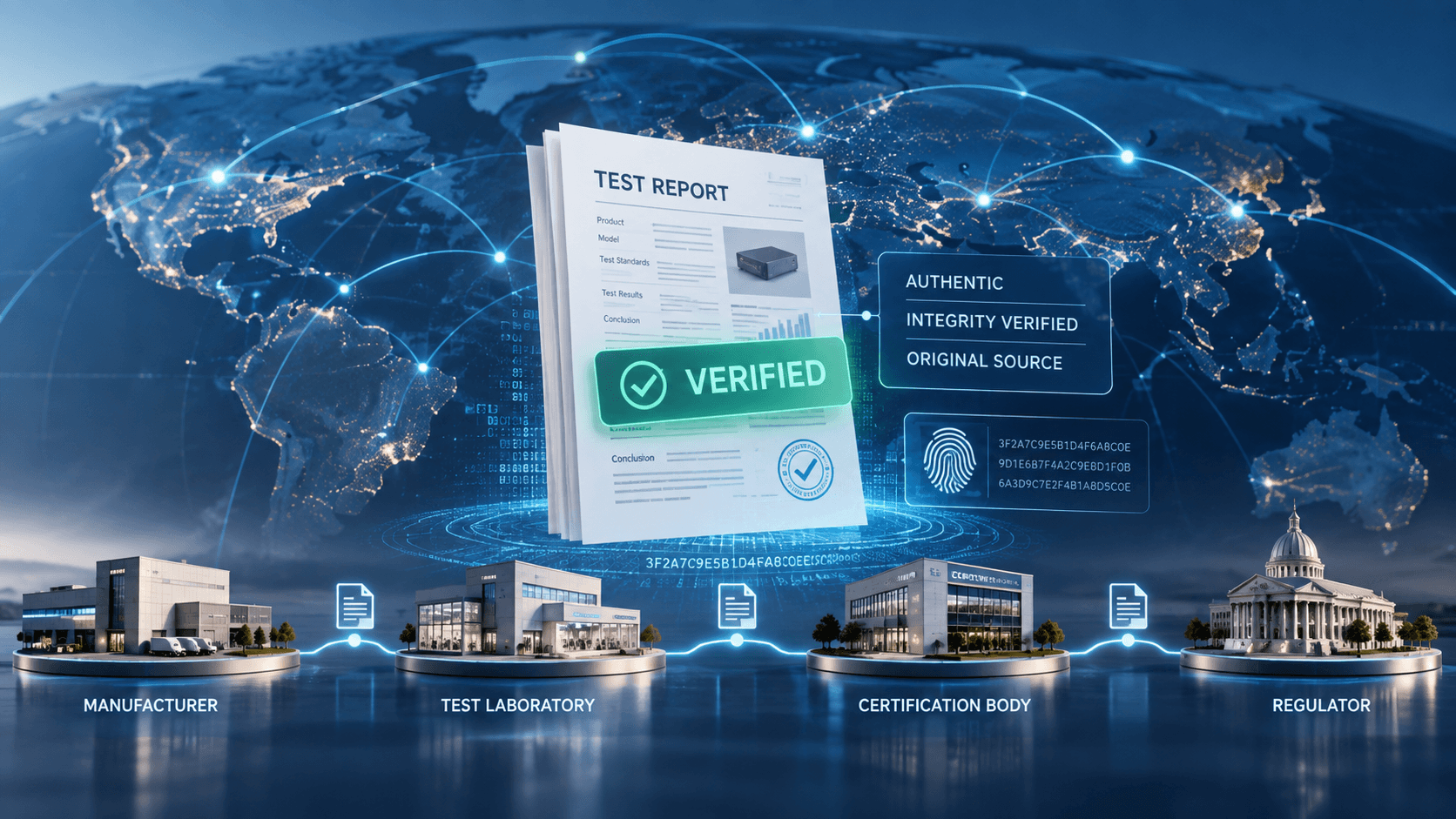
A typical compliance process can involve a manufacturer, a test laboratory, a certification body, a local representative and a regulator, often across several countries and IT systems. The same regulatory evidence may be downloaded, forwarded, stored and resubmitted multiple times.
For digital evidence to remain trustworthy, the recipient should be able to answer three questions independently: Did this document originate from the claimed source? Is it the same document that was originally authenticated? Has it remained unchanged since authentication?
Digital trust therefore cannot stop at the laboratory or certification body's door. It needs to follow the evidence throughout the regulatory chain.
ISED Canada: A Real-World Document Authentication Pilot
A significant real-world example is taking place in Canada. Innovation, Science and Economic Development Canada (ISED) is conducting a blockchain pilot involving compliance documents used in its equipment certification process.
According to ISED's September 2026 update, the objective is to trial blockchain technology for securing Testing, Inspection and Certification compliance documents moving through ISED's standard equipment application process, while exploring how verification of document authentication can be automated.
ISED reports that it is using an improved verification interface from Blockchain Verified Sweden. Hundreds of documents, including ISED test reports and Canadian representative letters, are being authenticated every month. Most significantly, ISED states that the verification interface has enabled the detection of manipulated PDF documents.
That finding matters. Document manipulation is sometimes discussed as a theoretical fraud or cybersecurity risk. The pilot demonstrates that document integrity is a practical issue that can be addressed through independent verification.
A Growing Ecosystem of Manufacturers and Laboratories
The pilot also shows that digital trust is not limited to one organization or one type of participant. ISED's latest update lists manufacturers including Apple, NVIDIA, Microsoft, Motorola Solutions, Rivian, Zebra Technologies, Icomera, Fronius International, Hamaton, Hunter Fan and SureCall.
Participating test laboratories listed by ISED include Element facilities in the United States and Korea, Sporton Taiwan, DEKRA Malaga, PHOENIX TESTLAB, TÜV SÜD UK, TÜV Rheinland Taiwan, UL Solutions UK, NMi TESTLAB and RF Safety Lab.
The importance is not simply the individual company names. It is the development of an ecosystem in which regulators, laboratories, manufacturers and representatives can all rely on independently verifiable evidence.
Digital Trust Is Becoming an International TIC Discussion
The subject is also moving beyond Canada. Blockchain Verified has presented its approach to digital trust and regulatory evidence at FCC/TCB-related conferences in the United States.
In September 2026, Blockchain Verified presented “Independent Digital Trust Infrastructure - Building Trust in Digital Test Reports, Certificates and Regulatory Evidence” at the Global ICT Testing & Certification Conference in Korea. The event brought together members of the regulatory and TIC communities from several Asian markets, including Korea, Malaysia, Thailand, Vietnam, Bangladesh and Cambodia.
This reflects a broader reality: product compliance is global while regulatory systems remain largely national. A test report may be produced in Taiwan, reviewed in Europe, submitted by a representative in Canada and used as evidence for access to multiple markets. Trust in that document therefore needs to work across organizations and borders.
Why Blockchain Is a Means, Not the Objective
For the TIC industry, blockchain should not be the objective. Trust is the objective. Blockchain is one technology that can help make that trust independently verifiable.
Blockchain Verified creates a cryptographic fingerprint, or hash, of a document and records evidence associated with that document in a blockchain-based verification infrastructure. The confidential document itself does not need to be publicly stored on the blockchain.
When the document is later presented, its fingerprint can be compared with the authenticated record. If the document has changed, even slightly, its fingerprint changes. This allows the recipient to verify integrity without relying solely on the party presenting the document.
That distinction is important. Blockchain does not decide whether a product complies with FCC, ISED, CE, RED or other requirements. It does not replace testing, certification or regulatory assessment. It protects the integrity of the digital evidence on which those decisions depend.
From Document Verification to Digital Trust Infrastructure
The next step may be even more important. ISED states that the pilot has been extended and that ISED and Blockchain Verified are exploring possible API integration to automate and accelerate verification of incoming exhibits.
This could move document authentication from a separate manual activity into the regulatory workflow itself: receive the document, automatically verify authenticity and integrity, and continue the application process.
At scale, that becomes more than document verification. It becomes digital trust infrastructure.
The Future of TIC Must Be Verifiably Digital
For decades, the TIC industry has built systems for establishing confidence in products, laboratories and certification processes. Accreditation establishes confidence in competence. Testing creates technical evidence. Certification establishes conformity.
Digital transformation adds another requirement: confidence in the authenticity and integrity of the digital evidence itself.
The ISED pilot shows that this is no longer merely a theoretical discussion. Hundreds of regulatory documents are already being authenticated every month, manipulated PDFs have been detected, participation is expanding, and automated verification through API integration is being explored.
At the same time, discussions within FCC/TCB communities and with regulators and TIC organizations internationally show that digital trust is becoming a broader industry topic.
The future of TIC will not only be digital. It will need to be verifiably digital.
The question for the industry is therefore shifting from “Do we need digital trust?” to “How do we build digital trust into the global compliance infrastructure?”
About Blockchain Verified
Blockchain Verified provides independent digital trust infrastructure for test reports, certificates and other regulatory evidence. By enabling organizations to verify the origin and integrity of digital documents, Blockchain Verified helps manufacturers, laboratories, certification bodies and regulators establish trust in compliance evidence beyond the systems in which those documents were originally created.