

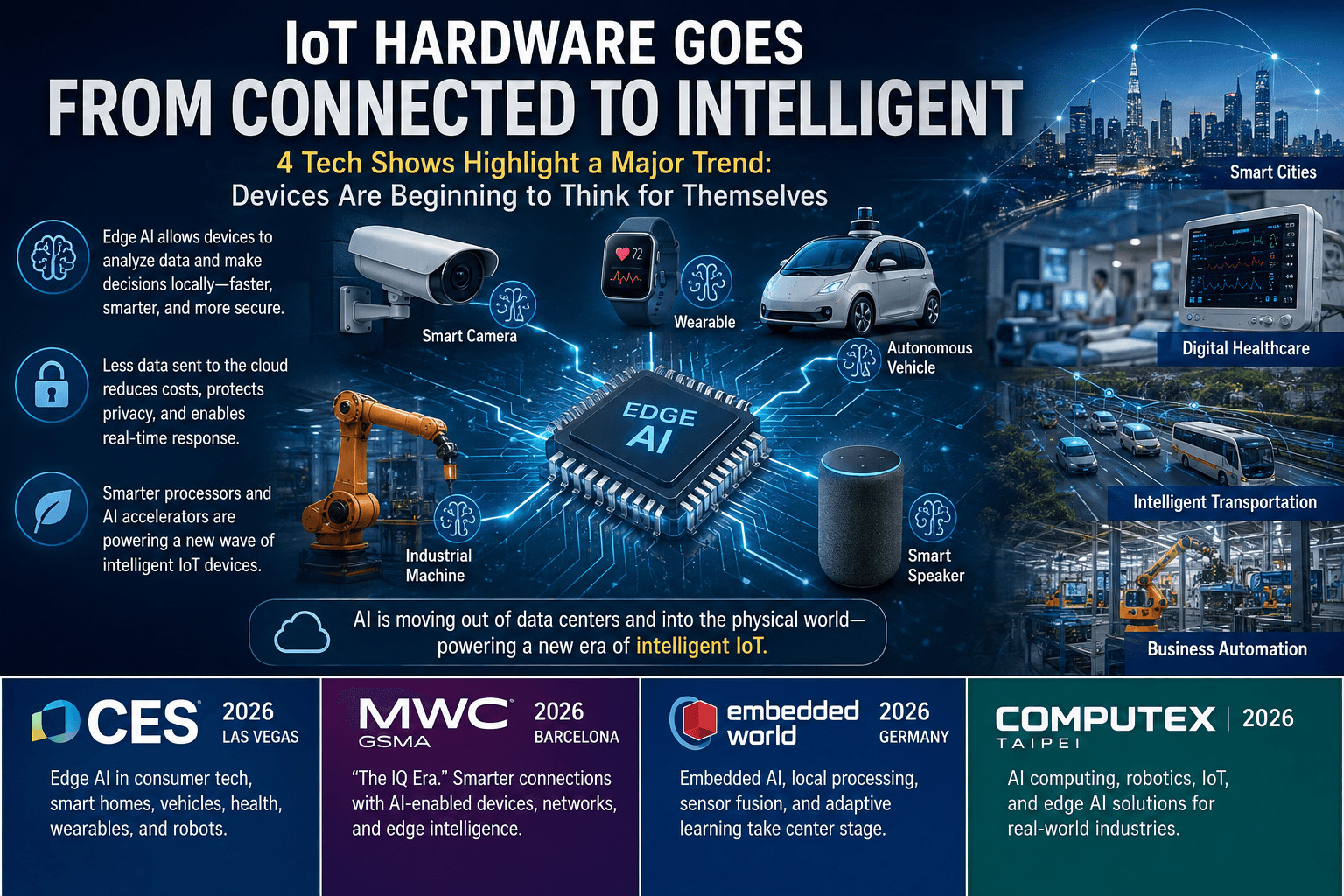
Before AI, the main purpose of an Internet of Things (IoT) device was to collect data and send it. A sensor measured temperature, movement, location, or some other condition and then sent that information to the cloud. Powerful computers in remote data centers analyzed the data and decided what should happen next.
Thanks to edge AI, today’s IoT devices are becoming powerful enough to analyze information themselves. Instead of sending everything to the cloud, a device can process data and make decisions locally.
The “edge” refers to where data is created, such as a camera, sensor, vehicle, wearable device, or factory machine. edge AI allows artificial intelligence to operate directly on or near that device.
Today’s more powerful microcontrollers and processors are helping make this possible. And many chipsets now also include special AI accelerators designed to run artificial intelligence efficiently. The result is a major shift from connected devices to intelligent devices.
Four Different Tech Sectors, One Major Trend
This change could be seen at four of the world’s most important technology trade shows in 2026. Each event focused on a different part of the technology industry, but all showed how intelligence is moving out of the cloud and into smart devices.
At CES 2026 in Las Vegas, edge AI appeared in consumer electronics, smart-home products, vehicles, healthcare technology, wearables, and robots.
CES described the technology behind IoT as more than connectivity. It now includes sensors, edge computing, secure data systems, and distributed intelligence. Together, these technologies support smart cities, digital healthcare, intelligent transportation, and business automation. CES identified edge AI and distributed computing as important parts of modern IoT infrastructure.
Mobile World Congress in Barcelona showed the same trend in the mobile and telecommunications industries. The theme of MWC26 was “The IQ Era.” It represented a move toward smarter connections. The focus was no longer only on making networks faster or allowing them to carry more data.
The GSMA, which organizes Mobile World Congress, announced an initiative to encourage the development of AI-enabled smartphones, wearables, connected vehicles, and robots. Its goal is to create an environment in which devices, networks, edge AI systems, and cloud platforms work together. Mobile World Congress also highlighted how edge AI can produce faster decisions, use less energy, and keep sensitive information closer to the user.
At embedded world 2026 in Germany, attention moved from finished products to the electronic parts inside them. Companies presented microcontrollers, processors, sensors, storage systems, and development tools designed for embedded AI. An embedded system is a small computer built into a larger product. Examples include the computer controlling a washing machine, a vehicle’s braking system, or a factory robot.
Instead of always following the same instructions, systems should eventually be able to adapt after deployment and respond to changes in their surroundings. The embedded world 2026 program identified local AI processing, sensor fusion, and adaptive learning as important areas of development.
COMPUTEX 2026 in Taipei showed how these technologies can be produced and used on a larger scale. Under the theme “AI Together,” the event focused on AI computing, robotics, intelligent machines, IoT, and edge AI. Exhibitors displayed small industrial computers and rugged AI systems designed for factories, transportation, healthcare, stores, and other demanding environments.
Together, these four exhibitions highlighted a clear message: AI is moving out of data centers and into the physical world.
Why Should AI Live on the Edge?
Cloud computing remains an important part of IoT. The cloud provides the enormous processing power needed to train AI models, analyze large amounts of data, coordinate thousands of devices, and manage systems from a central location. But sending every piece of data to the cloud is not always practical or efficient. edge AI can reduce connectivity and cloud costs.
Keeping data on a device can also improve privacy. A smart speaker might understand a voice command without sending the recording to a remote server. A camera could recognize that a person is present without uploading an identifiable image. A medical device could analyze private health information and transmit only the final result.
But local processing does not automatically make a device secure. Hackers may still try to access the device itself. However, storing and transmitting less personal information will reduce the amount of data at risk.
Smaller Processors, Larger Impact
The shift toward edge AI is possible because small processors have become much more powerful.
Modern microcontrollers can perform more calculations and handle more memory while using relatively little electricity. This is especially important for battery-powered sensors and wearable products.
Many chipsets now contain neural processing units or other AI accelerators. These are specialized parts of a processor designed to perform AI calculations faster and more efficiently than a general-purpose processor.
Software has also improved. Developers can compress AI models so they require less storage, memory, and energy. This allows useful AI features to operate on small devices that could not have supported them a few years ago.
As a result, an IoT device no longer has to be a simple data collector. It can now understand what it detects and take action.
Designing Hardware With Room to Grow
Processing power and memory still matter. However, manufacturers must now think about how to keep an intelligent device useful and secure for many years.
An IoT product designed today might remain in use for five, ten, or even fifteen years. During that time, AI technology will improve, new security threats will appear, and customers will expect new features.
Designers must therefore create hardware with room to grow. A device should have enough memory and processing ability to support future software and AI models whenever possible.
Secure updates are essential, and manufacturers need a safe way to install new software, fix security weaknesses, and replace older AI models. The device must also be able to confirm that an update is genuine and has not been changed by an attacker.
AI models may need regular attention as well. A model that works accurately when a product is launched may become less reliable when conditions change. Manufacturers will need to retrain, test, and update it.
Energy use, heat, cybersecurity, privacy, and government regulations must all be considered along with speed and memory.
Preparing for the Next Generation of Devices
Manufacturers should create products that can support greater intelligence in the future. New devices should use flexible designs, include extra computing capacity where practical, and support secure software and AI updates.
The rise of edge AI means devices, local edge systems, networks, and cloud platforms will share the work. Each task can be handled in the place that offers the best combination of speed, cost, security, and computing power.
A connected device can report what is happening. An intelligent device can understand what is happening and decide what to do next.
Stay up to date with the latest certification requirements for IoT devices anywhere in the world with IoT Consulting Partners Ltd. With more than 20 years of experience in product design, manufacturing, compliance testing, inspection, and certification, we’ll guide you from initial design to securing the market access approvals you need.